2026.02.24
 News
News
The automotive seat belt buckle is a critical safety component, and its performance, reliability, and feel are fundamentally dictated by the precision mold that creates it. Over decades, the molds used to manufacture these buckles have undergone significant performance changes, driven by evolving safety standards, material advancements, and manufacturing excellence. This evolution reflects a shift from crafting a functional latch to producing a sophisticated, user-centric safety device through ever-more-advanced molding technology.
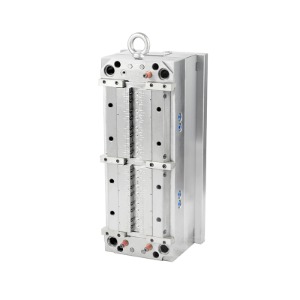
The performance evolution of automotive buckle molds can be traced through several key, interconnected phases.
Initially, molds were designed for basic functionality and durability. Early seat belt buckles were relatively simple mechanisms, and the molds focused on reliably forming the primary structural components—the frame, button, and latch—from engineered plastics. The primary performance metrics for these molds were uptime and the consistent production of dimensionally stable parts that could withstand basic mechanical testing.
A major shift occurred with the integration of sensory and electronic components. As safety systems advanced, buckles incorporated components for seat occupancy detection, buckle confirmation switches, and pretensioner initiators. This transformed mold design. Molds now needed to form intricate channels, delicate bosses, and ultra-precise cavities to house wiring, sensor tabs, and metal inserts. Performance became synonymous with holding tighter tolerances and achieving perfect alignment for insert-molding techniques, where plastic is shot around metal electrical contacts.
Concurrently, there was a heightened focus on ergonomics and aesthetic integration. The buckle transitioned from a utilitarian block to a sculpted, user-friendly interface. Molds began producing complex, Class-A surface finishes on the button and housing, often with textured grips or brand logos. This required molds with superior polishing, advanced cooling channel layouts to prevent sink marks on cosmetic surfaces, and actions like side-cores and lifters to form undercuts without leaving noticeable parting lines.
Today, the leading edge of mold performance is defined by intelligent systems and lightweighting. Modern high-performance molds incorporate conformal cooling channels—channels that follow the contour of the cavity—for faster, more uniform cooling, reducing cycle times and improving part consistency. They are also designed for new, high-strength polymers and composites that allow for thinner, lighter walls without sacrificing strength, meeting stringent vehicle weight reduction targets. The table below summarizes this technological trajectory:
|
Evolution Phase |
Key Driver |
Mold Performance Change |
|
Foundational Durability |
Basic Safety Standard |
Focus on robust construction for high-volume output of simple parts. |
|
Electromechanical Integration |
Enhanced Safety Systems |
Capability for insert molding, tighter tolerances for electronic components. |
|
Ergonomic Refinement |
Consumer Experience & Design |
Ability to produce complex geometries and high-surface-finish parts. |
|
Intelligent Lightweighting |
Efficiency & Weight Reduction |
Use of conformal cooling and designs for advanced, thin-wall materials. |
Material and Longevity Demands
Early buckle molds utilized good-quality tool steels but were susceptible to wear from abrasive glass-filled plastics. Today, molds are machined from premium, hardened steels or stainless grades like Stavax or German 1.2316, which offer superior resistance to corrosion and abrasion, extending service life.
Surface treatments have become commonplace. Technologies like Physical Vapor Deposition (PVD) coating apply a microscopic layer of titanium nitride or chromium nitride to the cavity. This dramatically increases surface hardness, reduces friction for better part release, and further resists corrosion from engineered plastics.
The move to high-flow, fiber-reinforced materials for lightweighting places extreme demands on the mold surface. These materials are highly abrasive. The combination of advanced substrate steel and protective coatings is now a performance necessity to maintain cavity precision over millions of cycles, ensuring every buckle meets its critical safety specification.
The functional tolerance of a buckle's internal latching mechanism is sub-millimeter. Modern molds achieve this through CNC machining and electrical discharge machining (EDM) at micron-level precision. Every detail of the latch path and spring post must be exact to guarantee the consistent "click" and holding force of the final assembly.
Consistency is measured across the entire production run. A high-performance mold must produce the first and the millionth part with identical mechanical properties and dimensions. This is achieved through stable thermal management. Advanced molds use sensor-regulated cooling systems to maintain a uniform cavity temperature, preventing part warpage or variations in material crystallization.
Performance includes automated post-mold operations. Leading molds are designed as part of a system, integrating robotic part removal, in-mold quality checks (e.g., vision systems to verify insert presence), and automatic degating. This integration minimizes human handling, reduces particulate contamination, and ensures a seamless, traceable manufacturing process for a safety-critical component.
Recommended Products



 English
 中文简体
中文简体 русский